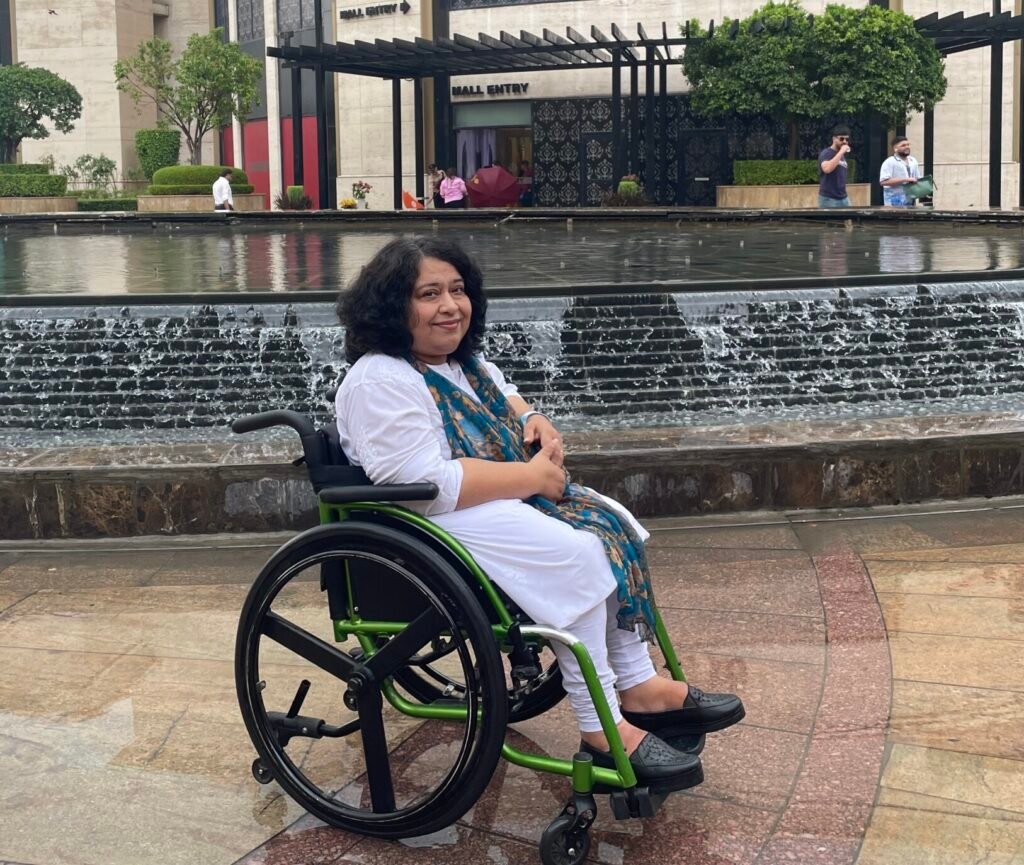

As a woman who has lived with the effects of polio for over five decades, my life has been a tapestry of resilience, advocacy, and constant learning. From overcoming the limitations of my disability to achieving recognition as a disability rights advocate, a President’s awardee, and the first woman in my country to receive the Henry Viscardi Award, my journey has been marked by success, growth, and an unrelenting desire to make a difference. But now, as I find myself in the throes of aging and battling Post-Polio Syndrome (PPS), I am faced with a new challenge that I never fully anticipated: the invisible limitations that come with the passage of time, the hidden toll of past struggles, and the reality of my body’s decline.
While the outward achievements and accolades reflect the life I’ve worked hard to create, the inner reality is more complex. Like many who are affected by both disability and the aging process, the intersection of these factors has led me to confront a new set of challenges. It’s a reality that is difficult to articulate, but one that can be better understood through the lens of the Spoon Theory.
Understanding Spoon Theory and its Relevance to My Life
The Spoon Theory, coined by Christine Miserandino in 2003, is a powerful metaphor that explains how people with chronic illnesses or disabilities manage their daily energy. Each day, a person with a disability is given a certain number of spoons—representing units of physical or mental energy. As the day goes on, each task or activity depletes a spoon. For someone with a disability or chronic illness, these spoons don’t regenerate easily, and it’s a constant balancing act between what must be done and what energy is available. By the time the spoons run out, the day is over, and the individual must rest and recover to regain their energy for the next day.
For me, the Spoon Theory resonates with an eerie familiarity. As a polio survivor, I’ve spent my life balancing my energy between work, advocacy, family, and self-care. In the early days, I had more spoons to give—fueled by youthful ambition and an unwavering desire to create change. I pushed through the physical limits and dedicated myself to disability rights advocacy, teaching, writing books, and serving as a counselor. However, as time has passed, I’ve noticed that my spoons are not as plentiful as they once were.
The Impact of Post-Polio Syndrome and Aging
Post-Polio Syndrome is a condition that affects polio survivors decades after their initial recovery. It manifests as new, often debilitating symptoms that may include muscle weakness, fatigue, and joint pain. The gradual onset of PPS is like a slow erosion of the strength and stamina that I once took for granted. It’s as if the body is finally catching up with all the years of overcompensating for the damage caused by the initial polio attack.
In the past, I could push through long days of work, travel, and meetings with a sense of purpose that kept me going. Now, I find myself running out of spoons much earlier in the day. I can no longer stay up late to finish a project, nor can I continue working on multiple tasks without feeling the physical toll. The fatigue is not just physical but mental as well. The weight of years of work, of advocacy, of breaking barriers—suddenly, it feels heavy, and the spoons are fewer.
In addition to the physical challenges of PPS, aging itself adds another layer of complexity. As we age, our bodies naturally lose strength and flexibility, and our energy levels decline. This is true for everyone, but for someone like me, whose muscles were already weakened by polio, the effects are magnified. The intersection of aging and disability makes simple tasks more exhausting and requires careful planning to ensure that each day’s spoons are spent wisely.
The Midlife Crisis: More Than Just a Phase
At this stage in my life, I am also navigating a midlife crisis, one that feels different from what I imagined when I was younger. It’s not just about questioning life choices or feeling uncertain about the future—it’s about reckoning with the limitations of my body, which no longer responds as it once did. It’s a quiet, sometimes overwhelming grief, recognizing that the energetic, ambitious woman who once could accomplish so much in a day now finds herself needing to rest more, ask for help, and say “no” to things she once took for granted.
This midlife crisis is not just psychological; it’s physical, emotional, and social. It’s learning to navigate a new reality where my energy is finite, and I must choose where to spend my spoons. It’s understanding that my advocacy and my work are still important, but the way I show up in the world may look different now. It’s accepting that my role as a change-maker doesn’t have to mean constantly running on empty, but rather finding new ways to be impactful without depleting myself.
Lived Experience and Spoon Theory: A Call for Understanding
Spoon Theory is more than just a metaphor; it’s a powerful tool for explaining the lived experience of people with chronic illnesses and disabilities. For those who don’t experience disability or aging, it can be difficult to understand why someone might seem “fine” one day and then suddenly “fall apart” the next. The Spoon Theory helps to shed light on this by illustrating how energy, both physical and mental, is finite, and how people with disabilities must constantly ration it to make it through the day.
When I share my experiences of fatigue and the need for more rest, I hope that Spoon Theory can help others understand that this is not a matter of laziness or lack of willpower—it is a matter of conserving precious energy. I hope it can foster empathy and compassion, not just for myself, but for others who are navigating similar journeys of living with disability, aging, and the invisible weight that comes with it.
As someone who has dedicated my life to advocacy, writing, and creating spaces for others to understand disability, I now find myself reflecting on my own journey in a new way. My story is still being written, and even though my spoons may be fewer than they once were, I continue to find purpose and meaning in what I do. The spoon theory has become a way for me to explain my reality to others, and it’s a reminder that, no matter how many spoons I have left, I will continue to advocate for inclusion, dignity, and the rights of people with disabilities, just in a way that is more sustainable for me.
A Final Thought: Embracing the Journey
Life has a way of changing the rules, especially when it comes to living with disability and aging. Yet, as we journey through these changes, it’s important to remember that it’s not the number of spoons we have that matters, but how we choose to use them. The challenge is not just in managing our energy but in continuing to find joy and fulfillment in the moments that remain, no matter how few our spoons may be.
For anyone who is grappling with similar challenges, whether through disability, aging, or chronic illness, I encourage you to consider your own spoons. Acknowledge their limitations, honor their worth, and know that even in the most difficult times, you have the power to make a difference, both in your own life and in the lives of others.